
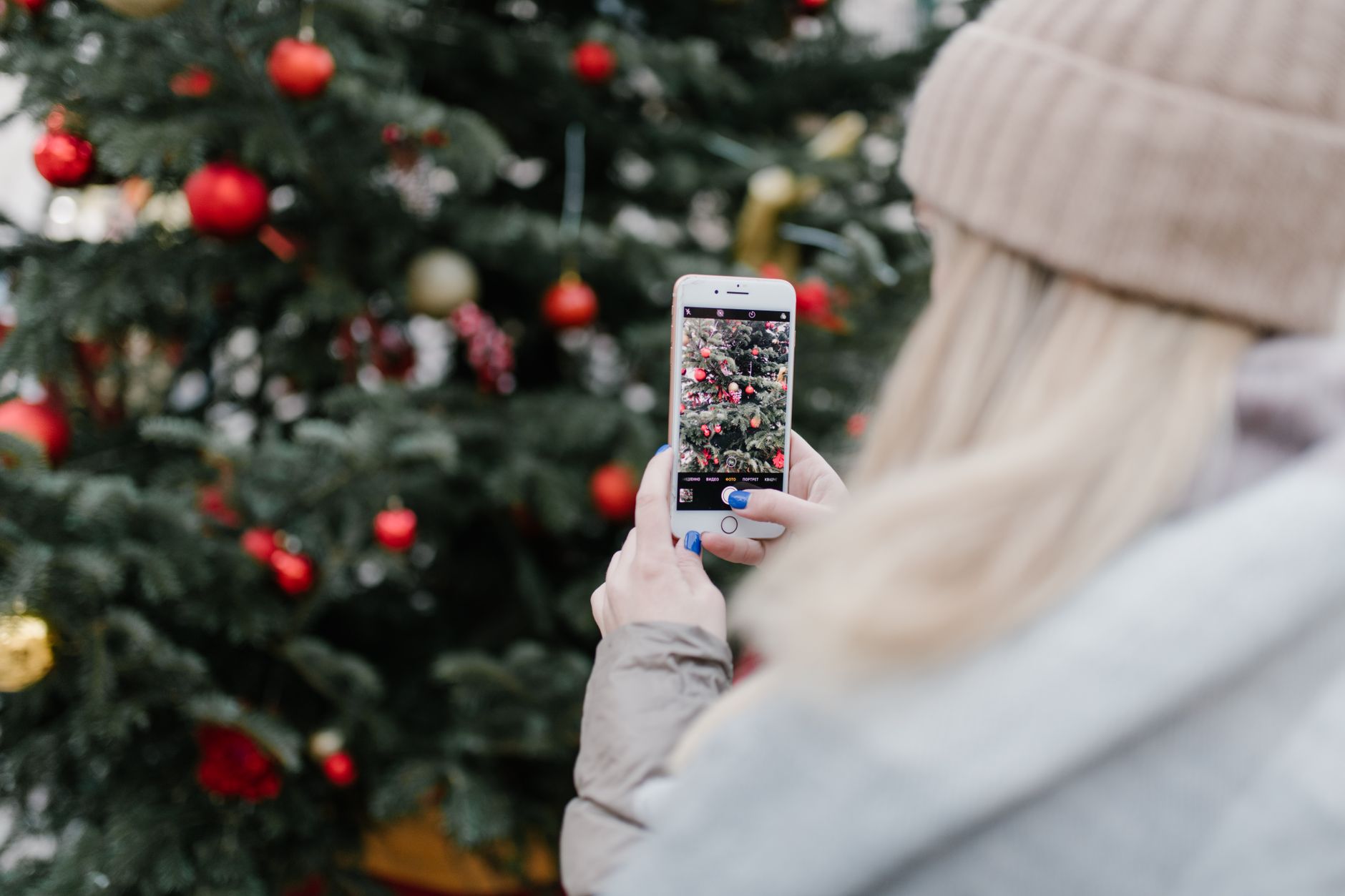
Last December I bundled everyone into the car after dinner, drove to the best-lit street in our neighborhood, and took a whole pile of photos of it. Every single one looked the same: tiny bright blobs floating in a black void, with a murky gray smear where the houses should have been. The street looked magical in person. On my phone it looked like a screensaver from 2004.
The problem wasn’t my phone, and it wasn’t my hands. It was the clock. If you want to know how to photograph Christmas lights so they look the way they feel, the most important setting is the time you leave the house, and in December that’s a lot earlier than you think.
The best Christmas light photos happen before it’s fully dark
Almost every Christmas lights tutorial tells you to shoot during “blue hour.” That’s good advice, and then it stops. Nobody tells you blue hour isn’t an hour, or that in December it’s over before most of us have finished work.
What photographers call blue hour lines up roughly with civil twilight: the stretch after sunset when the sun is less than 6 degrees below the horizon. The sky still holds some deep blue light, which is enough to show rooflines, trees and snow, but it’s dark enough that the bulbs glow. Your camera can expose for both at once. Once the sky goes black, your phone has to choose. Expose for the lights and the houses vanish. Expose for the houses and the lights blow out into white blobs.
So I ran the numbers for this year using NOAA’s solar calculator equations, and the results surprised me.
How to photograph Christmas lights in December: your window is about 32 minutes
Take Chicago on Saturday, Dec. 12. The sun sets at 4:19 p.m. and civil twilight ends at 4:52 p.m. That’s a 32-minute window. The sweet spot, when the sky and the lights look balanced, tends to sit in the middle of it, roughly 15 to 25 minutes after sunset. In Chicago that’s about 4:34 to 4:44. My after-dinner trip at 7 p.m. last year arrived more than two hours after the good light was gone.
Now multiply it out. If you only have weekends, there are six weekend evenings between Dec. 5 and Dec. 20. Six times 32 minutes is 192 minutes, or a little over three hours of good light for the whole season. That’s it. Miss a couple of Saturdays to parties and you’re down to two hours.
Where you live changes the size of the window. Twilight lasts longer the farther north you are, because the sun sets at a shallower angle. On Dec. 12, New York gets about 31 minutes (sunset 4:28, twilight ends 5:00). Seattle gets almost 37 minutes (4:17 to 4:54). Dallas gets 28 (5:21 to 5:49), and Miami gets less than 26 (5:31 to 5:57). Run my six-weekend math for Miami and you get about 2.6 hours for all of December, versus 3.7 hours in Seattle. If you’re in the South, you have less margin, so get there early.
The window doesn’t move much either. On Dec. 21, the shortest day of the year, Chicago’s sunset is only three minutes later (4:22) and twilight still lasts about 32 minutes. Whatever time works on the first weekend works on the last.
Your phone’s Night mode is trying to help, and that’s the problem after dark
Here’s why the full-dark photos look so muddy. According to Apple’s own support page, Night mode turns on automatically when the camera detects a low-light environment, and it picks its own capture time, shown in seconds next to the Night mode icon. That’s great for a dim restaurant. On a pitch-black street, in my experience, it lifts the sky into a noisy gray and blooms every bulb into a halo.
During twilight, the sky gives your phone enough light that Night mode either stays off or runs a much shorter capture, so the photo stays crisp. If it still kicks in, brace your phone on a car roof or a mailbox or use a tripod, and keep still until the capture finishes. Apple also notes that Live Photos and the flash turn Night mode off, which matters if you’re trying to force it either way. My other trick: tap on the brightest part of the display, then slide the exposure down a notch. Slightly darker almost always looks richer with lights.
If you’re shooting people in front of the display (the kids, the dog in the reindeer sweater), the twilight window matters even more. A long Night mode capture blurs anyone who moves, which is every child I’ve ever met. I covered more of that in my DIY Christmas card photo tips, and the same rules apply here: steady phone, soft light, a lot of shots.
Your own house is the easiest shot of all, if you change one thing
Most of us light our houses on a timer or a photocell, which waits until it’s dark. That’s exactly the wrong time for a photo. The Woods 2001WD outdoor timer with a photocell sensor costs $10.73 at Home Depot, and like most of them it turns lights on at dusk. For photo night, skip the sensor and plug the lights in yourself about 10 minutes before sunset, so the bulbs are already glowing when the sky turns that deep blue.
You also have more lit-up houses to choose from than you might think. In This Old House’s 2024 survey of 3,000 adults, 64% planned to hang outdoor lights, and 51% of decorators planned to have them up by the day before Thanksgiving. December 1 was the single most popular start date. In other words, the first weekend of December is when the neighborhood is fully lit, and that’s when you should go out.
Twenty good minutes beat a hundred photos in the dark
Photutorial estimated that about 2.1 trillion photos would be taken worldwide in 2025, and that 94% of them come from smartphones. If your camera roll from last December looks like mine, most of those are the same black-sky blobs, kept out of guilt and eating phone storage. Fewer photos in the right 20 minutes would have left me with more keepers, not fewer.
So this year, I’m treating the lights like a sunset. Look up your sunset time (your weather app shows it), be on the sidewalk 10 minutes before, and shoot until the sky stops being blue. Then go get hot chocolate. If you want more practice with low-light phone shots before December, my guide to photographing the Perseids with a phone uses a lot of the same steadying tricks. Knowing how to photograph Christmas lights mostly comes down to being there at 4:30 instead of 7.