
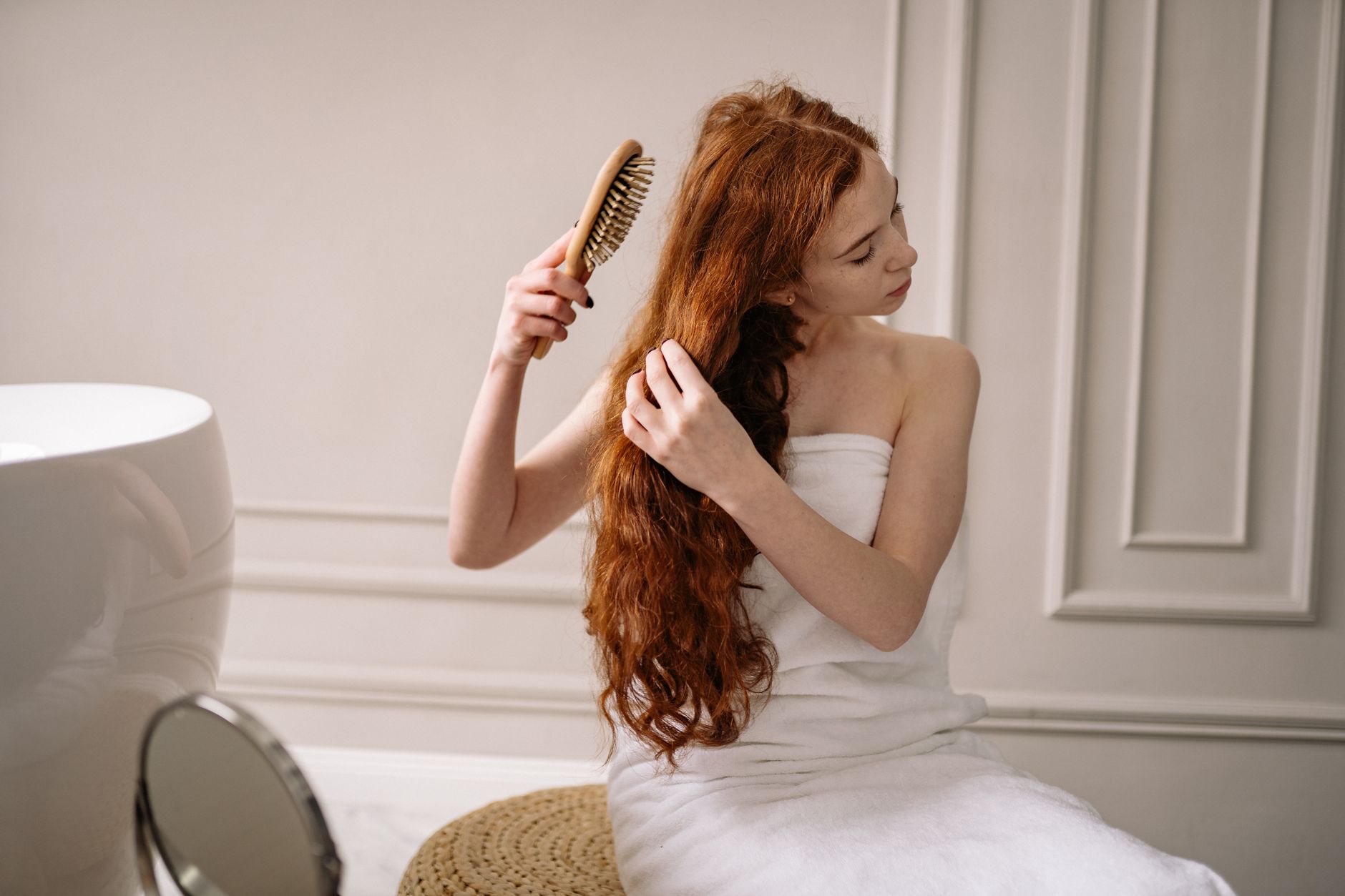
Every November there’s a morning when I pull off my beanie in the office elevator and my hair rises up to meet the ceiling light like it’s trying to leave without me. Last winter I finally got annoyed enough to look into how to get rid of static hair properly, and what I found was a little embarrassing. I’d been spending money on the wrong kind of frizz product, wearing the worst possible hat, and ignoring a fix that was already sitting in my shower in a pump bottle.
Static and summer frizz look alike in the mirror, but they’re close to opposites. One is your hair drinking up too much water from humid air. The other is your hair drying out so completely that it can’t get rid of an electric charge. Treat winter flyaways like July frizz and you’re paying to fix a problem you don’t have.
Static hair is a charge problem, and dry air is why it won’t go away
When two materials rub together, electrons hop from one to the other. Your hair is on the side that gives electrons away, so after a brush or a hat it ends up positively charged, and every strand carries the same charge. Same charges repel. That’s the halo.
In summer, a thin layer of moisture on each strand lets that charge leak away almost as fast as it builds. In winter it can’t. A 1985 study in the Journal of the Society of Cosmetic Chemists by M. L. Garcia measured how hair holds a charge, and found that at low humidity hair fibers “behave like typical insulators,” with charge that can hang around more or less indefinitely. Desco, a company that makes static-control gear for electronics factories, gives a sense of how big the swing is: walking across a carpet at 10% relative humidity can build about 35,000 volts on your body, versus about 7,500 at 55%.
And heated homes get very dry. A study of 678 Swedish homes, published in the REHVA Journal in 2021, found roughly 37% of them sat in the two driest humidity categories during the heating season, with most of the lowest readings under 20%. You don’t need to live in Sweden to recognize that. If your hands crack and your sweaters spark in January, your hair is living in the same air.
Anti-frizz sprays are built for humidity, not static
This is where I’d been wasting money. The bestselling frizz products are designed for summer. Color Wow Dream Coat, one of the best-known frizz sprays around, costs $28 for 6.7 ounces at Target, and its listing promises to stop frizz “even in the worst humidity.” It never mentions static. That makes sense, because the product is designed to keep water out of your hair, which is the reverse of what you need in a dry January office.
The static guides I read last winter all recycled the same three tricks: rub a dryer sheet over your hair, mist on some hairspray, run a humidifier. The humidifier helps for the reason above. The other two are stopgaps. What none of them told me was which ingredient to look for on the back of a conditioner bottle, and that turned out to be the most useful thing I learned.
The ingredient that fights static is a long-chain cationic conditioner
Garcia also tested what cuts the charging down. Long-chain cationic surfactants, the positively charged ingredients that make conditioner feel slippery, made the biggest difference. They lowered hair’s tendency to trade electrons in the first place and helped any charge that did build up drain away faster. The length of the molecule mattered. The longer versions (16 and 18 carbons) worked much better than short ones. The cationic polymers that also show up in some conditioners were less reliable.
On a label, the long-chain ones look like this: cetrimonium chloride (a 16-carbon chain), steartrimonium chloride (18), and behentrimonium chloride (22). Behentrimonium is even longer than the chains Garcia tested, so I can’t promise it’s better, but it belongs to the same family.
You don’t need a salon bottle to get them. TRESemmé Rich Moisture conditioner costs $7.97 for 39 ounces at Walmart, and its ingredient list includes both behentrimonium chloride and cetrimonium chloride in the top eight. Check whatever conditioner is already in your shower before you buy anything new.
The math: a fingertip of conditioner costs less than a penny
The change that made the biggest difference for me was using my rinse-out conditioner as a tiny leave-in on dry days, smoothed over the outer layer and ends after I style.
At $7.97 for 39 ounces, the TRESemmé works out to about 20.4 cents an ounce. An ounce is six teaspoons, so a quarter teaspoon, which is plenty for my shoulder-length hair, is a twenty-fourth of an ounce. That’s 20.4 divided by 24, or about 0.85 cents a day. If I do it every day from now until the first day of spring (130 days, November 11 through March 20), that’s about $1.11 for the whole winter.
Now compare it with the frizz spray. Dream Coat at $28 for 6.7 ounces is about $4.18 an ounce, roughly 20 times the price per ounce of the conditioner, for a product that wasn’t designed for this problem. Even if a bottle lasted you all season, you’d be paying $28 against $1.11.
Use a light hand. Too much leave-in on fine hair just looks greasy by lunch, so start with less than you think and add a drop if the halo comes back.
Your hat and your brush are generating the charge
The other half of the fix is to stop building so much charge in the first place. On the triboelectric series (the chart physics teachers use to show which materials trade electrons), hair, wool, and silk all sit near each other on the positive side. Polyester and acrylic sit far down on the negative side. The farther apart two materials are on that list, the more charge they swap when they rub.
So that cute acrylic beanie is close to the worst thing you could pull over your head in January. A wool or cashmere hat, or one lined in silk or satin, rubs against your hair with much less of a gap. If you’re shopping for one, my post on whether cheap cashmere is worth it covers how to tell a good knit from one that will pill by February. Garcia’s study also tested hair rubbed against polyethylene, a common plastic, which is a decent reminder to swap the plastic brush for a boar bristle or wooden one in winter.
And if your skin is feeling it too, my post on winter dry skin and indoor humidity deals with the same dry air from the other side.
My winter static routine, start to finish
These days I wash with a conditioner that lists cetrimonium or behentrimonium chloride near the top. On dry days, I smooth a quarter teaspoon over the outside of my hair after styling. I wear a wool hat instead of the acrylic one, and I keep a wooden brush in my bag for touch-ups. That’s it. My total new spending this winter was a $7.97 bottle I’d have bought anyway.
Learning how to get rid of static hair turned out to be less about buying a miracle product and more about reading the back of a bottle I already owned. Check yours tonight. There’s a decent chance the fix is already in your shower.