
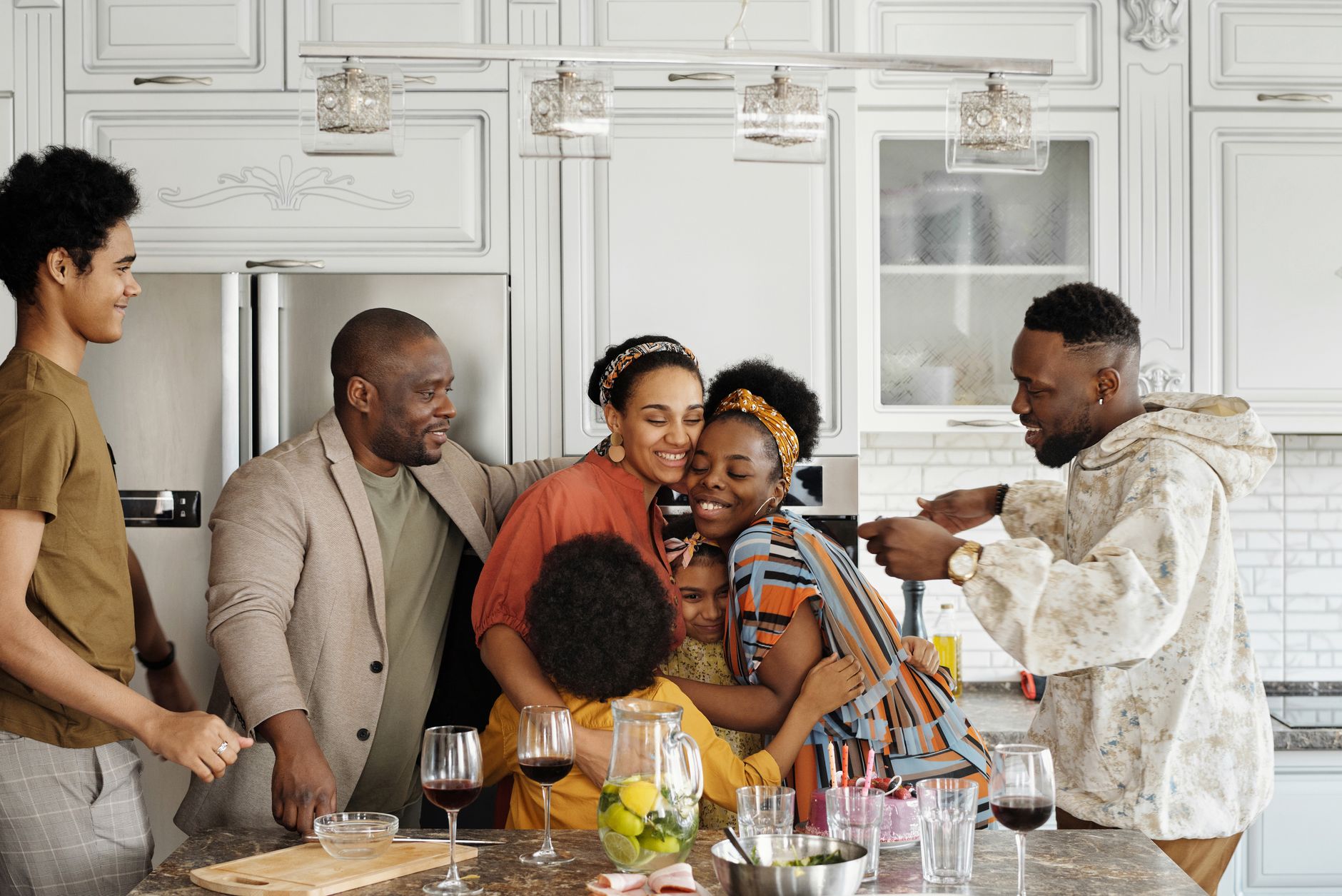
You line up twelve relatives in front of the fireplace after dinner, take eleven photos, and somebody has their eyes shut in every one of them. Never the same person, which somehow makes it worse. It feels like bad luck. It isn’t. A physicist worked out the odds almost twenty years ago, and his math points to two fixable mistakes: taking the picture at the wrong time of day, and trusting your phone’s low-light mode to bail you out.
I’ve started planning my own Thanksgiving family photo around those numbers, and I think you should too.
A physicist already calculated how many shots you need
In 2006, Piers Barnes, a physicist at Australia’s national science agency CSIRO, built a formula for blink-free group photos. Live Science reported that his model assumes people blink about 10 times a minute when being photographed, that each blink lasts around 250 milliseconds, and that a typical camera shutter in decent light is open for about 8 milliseconds. Put those together and each person has a small chance of being mid-blink in any frame. Multiply that chance across everyone in the group and it adds up fast.
His rule of thumb is easy to remember. For groups under 20, divide the number of people by 3 if the light is good, or by 2 if the light is bad. That’s roughly how many photos you need for better than a 95% chance that at least one comes out with everybody’s eyes open. Country Life’s write-up adds the less cheerful part: with 50 or more people, you have almost no chance of a clean shot at all.
The worked math for a 12-person Thanksgiving family photo
Let me run it for a table of 12, a pretty typical Thanksgiving crowd once the cousins show up.
The chance that one person isn’t blinking during a shot is 1 minus (blinks per second times blink-plus-shutter time). Ten blinks a minute is about 0.167 blinks per second. A 250-millisecond blink plus an 8-millisecond shutter is 0.258 seconds. Multiply those and you get about 0.043, so each person has roughly a 95.7% chance of having their eyes open in any given frame.
For all 12 at once, you multiply 0.957 by itself 12 times. That comes out to about 59%. So any single photo of the whole family has slightly better than coin-flip odds. Take 4 photos (12 divided by 3) and the chance that every one of them has a blinker drops to about 0.41 to the fourth power, roughly 3%. That’s a 97% chance you’ve got a keeper. In dim light, Barnes says to divide by 2 instead, so you’d want 6.
That’s very manageable. Four to six taps of the shutter, and you’re done before anyone’s stuffing gets cold. Which brings me to the part I got wrong.
Why the after-dinner photo needs dozens of shots
Most families take the group photo after dinner, inside, with the lamps on. By then it’s dark. On Thanksgiving, November 26, the sun sets around 4:21 p.m. in Chicago, 4:22 in Seattle, 4:30 in New York, and 5:21 in Dallas, by my calculation using standard solar equations. If you eat at 3, the light is gone before the pie is.
That’s when your phone quietly changes the rules. According to Apple’s Night mode support page, Night mode turns on automatically when the iPhone detects a low-light scene, and darker scenes take longer to capture, anywhere from a quick shot to several seconds. Apple also says to keep the phone steady until it finishes.
Here’s the problem. Barnes’s whole model rests on a shutter that’s open for a few milliseconds. If you plug a 1-second capture into the same formula (a simplification, since the phone blends several frames, but a useful way to see the risk), each person’s chance of a blink-free frame drops from 95.7% to about 79%. For 12 people, 0.79 to the 12th power is about 6%. To get a 95% chance of at least one good frame, you’d need about 48 photos. And that’s before you factor in your nephew who can’t stand still for one second, let alone three.
So those eleven after-dinner photos from the opening? Eleven sounds like plenty. By the math, it isn’t close.
The fix is to move the photo, not to take more of them
You could stand there and take 48 pictures while your dad asks if you’re done yet. Or you could take the photo while there’s still daylight.
My plan this year is simple. Everyone lines up by the biggest window in the house about an hour before sunset, before we sit down to eat. Nobody has gravy on their sweater yet, the kids haven’t melted down, and the light is soft and flattering. I’ll take 6 shots to be safe (12 divided by 2, in case it’s an overcast day) and check them right there on the screen. If one is clean, we’re done in under five minutes.
If daylight just isn’t happening at your house, give your phone more light so it doesn’t need a long capture. Turn on every lamp in the room and move everyone close to the brightest one. Apple notes that turning on the flash or Live Photos switches Night mode off, so that’s another way to force a shorter capture, though direct flash isn’t the most flattering look. Either way, plan on the low-light number (divide by 2) and then double it, because you can’t be sure how long your phone is holding the shutter.
Put yourself in the shot and count yourself in
One more number. Shutterfly’s 2026 Family Photo Representation Study of 1,001 parents found that 51% of moms say they’re usually the one taking the photos, compared with 37% of dads, and that moms show up in photos with their kids 31% less often. If that’s you, use your phone’s timer and a tripod or a stack of cookbooks, and get in the picture.
Just remember to add yourself to the count. Twelve people plus you is 13, so in good light that’s 13 divided by 3, about 4 or 5 shots. Burst mode helps here too, since it fires off a quick run of frames while everyone is still holding their smile.
If you want more on getting your phone set up, I wrote about using a cheap tripod for a DIY Christmas card photo, and the same setup works for this. And since it’ll be dark by 4:30 for the next month anyway, my guide to photographing Christmas lights during blue hour covers the evening shots. For the Thanksgiving family photo, though, take it in daylight, take more shots than feels necessary, and stop once you’ve got one where everybody’s eyes are open.