
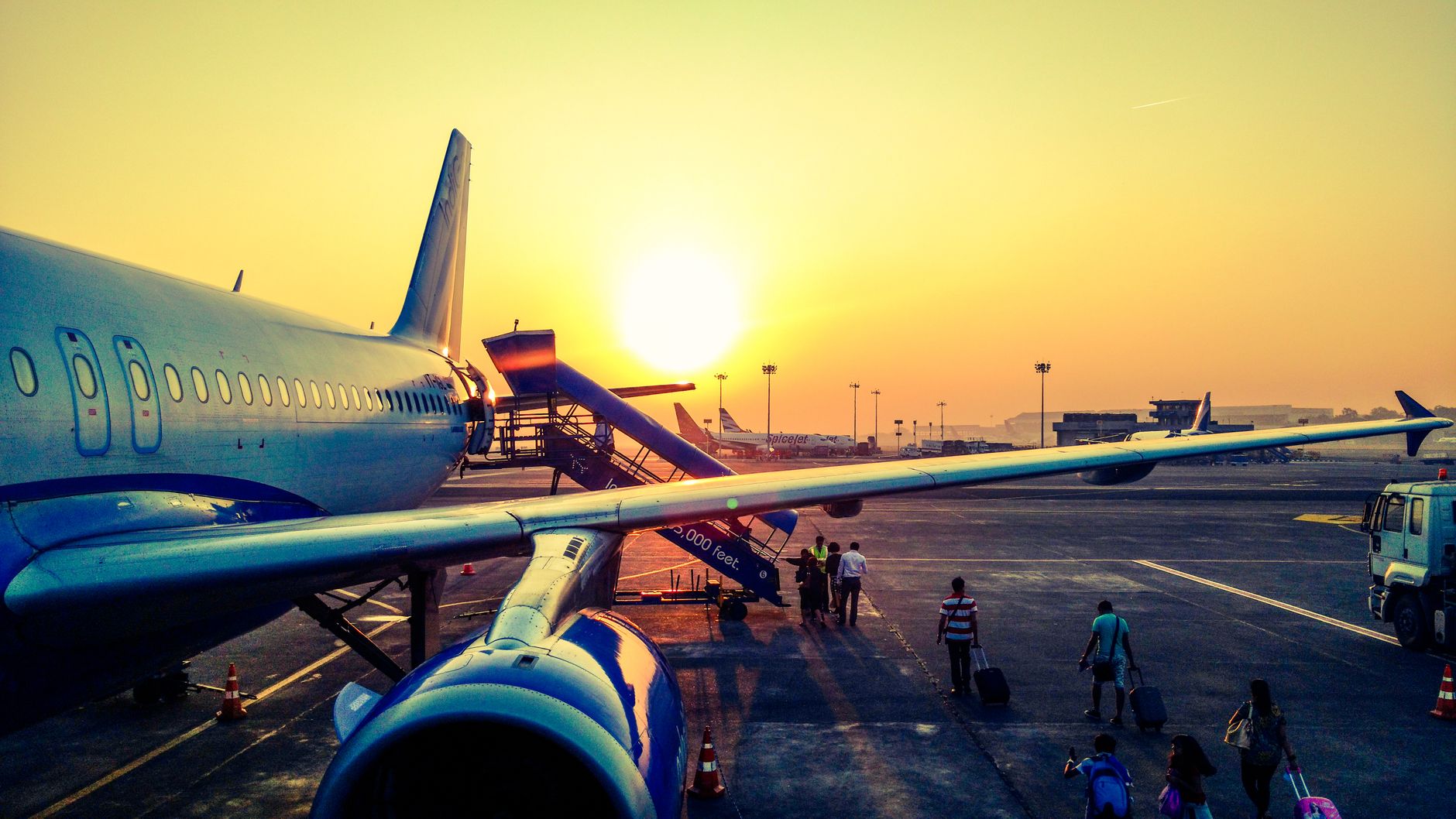
For years I booked the 4 p.m. flight home for Christmas because it let me sleep in, finish packing like a civilized person, and still make dinner. Then I spent one too many evenings on a gate-area carpet watching the departure board flip from “On Time” to “Delayed” in 20-minute increments. If you want the best time to fly to avoid delays, it isn’t a day of the week. It’s the hour on your boarding pass, and for a trip with a connection, picking the right one can roughly double your chances of getting there without a hitch.
December is already the hardest month to be on time
Start with the baseline, because holiday flying begins in a hole. In December 2025, U.S. airlines got 71.7% of flights in on time and canceled 1.6% of them, according to the Department of Transportation’s Air Travel Consumer Report. That’s out of 644,987 scheduled flights. Two months earlier, in October 2025, the same report showed 79.5% on time and a 0.6% cancellation rate.
So in the month you most want things to go smoothly, more than one flight in four lands late (DOT counts a flight as late at 15 minutes past schedule) and cancellations run more than double the October rate. Winter storms explain part of that. The rest comes from how a delay spreads through the day.
Delays snowball because your plane is still somewhere else
Most “fly early” tips stop before explaining why it works. The single biggest cause of delays in the October 2025 DOT data wasn’t weather or air traffic control. It was “late-arriving aircraft,” which accounted for 48,172 flights, 7.21% of every flight that month. That category beat the airlines’ own problems (6.02%) and the national aviation system, which covers air traffic control and heavy traffic (6.16%). Extreme weather on its own was 0.40%.
December makes the chain worse. In the December 2025 report, late-arriving aircraft delays hit 11.75% of American Airlines’ network flights and 10.16% of Alaska Airlines’ network flights, well above the 7.21% systemwide figure from October. That’s the snowball in holiday form, usually starting with a winter storm somewhere on the map that your plane flew through before it got to you. One late morning leg can touch every flight that aircraft operates for the rest of the day.
A late-arriving aircraft delay means your plane was late because its previous flight was late. A single plane often flies several legs in a day, and every leg inherits the problems of the one before it. A thunderstorm in Atlanta at 10 a.m. becomes a delay in Denver at 2 p.m. and a missed connection in Chicago at 7 p.m. The first flight of the morning mostly escapes this, because that plane usually spent the night at the airport, and there’s no earlier leg yet to run late.
You can see the pileup hour by hour. Thrifty Traveler’s analysis of DOT on-time data through Cirium found that in July 2024, flights leaving at 7 a.m. and 8 a.m. departed on time 84.3% of the time. Flights at 7 p.m. managed 59.6%, and after 10 p.m. it was 53%, with an average delay of 33 minutes. Charlotte, a huge connecting hub, went from 82% on time at the start of the day to 37% between 6 p.m. and 10 p.m.
The best time to fly to avoid delays doubles your connection odds
The best time to fly to avoid delays gets much clearer once you put a connection in it. Say you’re flying home for Christmas with one connection, so two legs. I’ll use those July 2024 hourly rates, since they’re the cleanest by-the-hour numbers out there, and I’ll treat each leg separately. (In real life a late first leg makes a late second leg more likely, so this is generous to the evening.)
Book the 7 a.m. departure and connect in the late morning. Each leg has roughly an 84.3% chance of leaving on time, so the odds that both do are 0.843 times 0.843, or about 71%. Now book a 7 p.m. departure with a connection that leaves around 9 p.m. Your first leg leaves on time 59.6% of the time and the second about 58.5% of the time (the 9 p.m. rate). Multiply 0.596 by 0.585 and you get about 35%.
That’s 71% versus 35%. The morning trip is about twice as likely to run on schedule from start to finish, and that’s in summer, before you apply December’s worse baseline. A morning delay also leaves you room. If the 7 a.m. flight cancels, there are usually several more flights that day to rebook onto. If the last flight of the night cancels, you’re often looking at tomorrow morning and a hotel.
Sort by departure time before you sort by price
I’ve switched to the first or second departure of the day for every holiday trip, even when it means a 4:30 a.m. alarm. Before you book, sort the search results by departure time, not price, and check whether the cheaper fare is cheaper because it leaves at 6 p.m. Sometimes that’s exactly why.
If you have to connect, pick a connection in the first half of the day and give yourself a longer layover than the minimum the app offers. An hour and a half at a big hub feels long when you’re booking and short when your first leg pushes back 40 minutes. Try to keep both legs on one ticket too, because if a delay makes you miss a separately booked flight, that’s your problem, not the airline’s.
Pack like you might get stuck. A carry-on with a change of clothes and any medication means a missed connection is an annoying night instead of a disaster. That also helps with the fees, which I broke down in the checked bag fees for holiday travel post. If you’re still deciding when to buy the ticket, my notes on the cheapest time to fly in winter pair well with this.
A 4:30 alarm is a fair price for a 71% trip
The early flight has real costs. You’ll be tired, you may be paying for a 5 a.m. ride or airport parking you’d otherwise skip, and if you have kids, the predawn wake-up isn’t nothing. I still think it’s worth it. A tired morning is predictable. An evening of rolling delays isn’t, and in December the evening is when the day’s problems pile up.
If you take one thing into booking season, take this: the best time to fly to avoid delays is the first wave of the morning, and the bigger the trip (connections, kids, a Christmas Eve dinner waiting at the other end), the more that early slot matters.